Hydrostatic Pressure

At a point,

P=lim⁡δA→0δFδAP = \lim_{\delta A \to 0} \frac{\delta F}{\delta A}

Pascal's Law

The hydrostatic pressure at a point is the same from all directions.

Variation Along Directions

Let pp be the pressure at the point A≡(x,y,z)A\equiv (x,y,z).

p=f(x,y,z)p = f(x,y,z) dp=∂p∂xdx+∂p∂ydy+∂p∂zdzdp = \frac{\partial p}{\partial x} \text{d}x + \frac{\partial p}{\partial y} \text{d}y + \frac{\partial p}{\partial z} \text{d}z

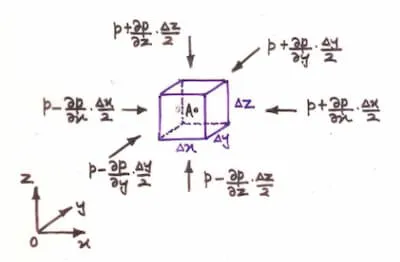
By considering equilibrium of this fluid element containing AA.

Fluid element containing point A

In the xx direction,

(p−∂p∂xΔx2)ΔyΔz−(p+∂p∂xΔx2)ΔyΔz=0\bigg( p - \frac{\partial p}{\partial x} \frac{\Delta{x}}{2} \bigg) \Delta{y} \Delta{z} - \bigg( p + \frac{\partial p}{\partial x} \frac{\Delta{x}}{2} \bigg) \Delta{y} \Delta{z} = 0 ∂p∂x=0\frac{\partial p}{\partial x} = 0

Similarly ∂p∂y=0\frac{\partial p}{\partial y} = 0 can be proven.

In the zz direction,

(p−∂p∂zΔz2)ΔxΔy−(p+∂p∂zΔz2)ΔxΔy−ΔxΔyΔzρg=0\bigg( p - \frac{\partial p}{\partial z} \frac{\Delta{z}}{2} \bigg) \Delta{x} \Delta{y} - \bigg( p + \frac{\partial p}{\partial z} \frac{\Delta{z}}{2} \bigg) \Delta{x} \Delta{y} - \Delta{x} \Delta{y} \Delta{z} \rho g = 0 ∂p∂z=−ρg\frac{\partial p}{\partial z} = -\rho g dp=−ρg dzdp = -\rho g\,\text{d}z p=−∫ρg dzp = -\int{\rho g\,\text{d}z}

Isobar

Surface of constant pressure.

Types of Pressure

Atmospheric Pressure

Pressure exerted by atmospheric air.

Gauge Pressure

Measured in respect to atmospheric pressure.

Absolute Pressure

Measured in respect to perfect vaccum.

Absolute Pressure=Atmospheric Pressure+Guage Pressure\text{Absolute Pressure} = \text{Atmospheric Pressure} + \text{Guage Pressure}

Piezometric Pressure

P=−ρgz+cP = -\rho gz + c P+ρgz=c=P∗P + \rho gz = c = P^{*}

Pressure Diagram

A diagram showing the variation of pressure along a submerged surface.

Pressure Head

Height of a particular fluid column that will produce the pressure at a point.

Pressure head=h=pγ\text{Pressure head} = h = \frac{p}{\gamma}

Pressure Difference Between 2 Points

Suppose there are 2 points A,B\text{A},\text{B} with a height difference of hh.

P1=−ρgz1+cP_1 = -\rho gz_1 + c

P2=−ρgz2+cP_2 = -\rho gz_2 + c

P2−P1=−ρg(z2−z1)=−ρg(−h)=hρgP_2 - P_1 = -\rho g(z_2 - z_1) = -\rho g (-h) = h \rho g

P2=P1+hρgP_2 = P_1 + h \rho g

Written by October 19, 2026 1 min read
Was this helpful?