A branch of mechanics, which deals with motion of bodies.
2 parts:
- Kinematics
The study of geometric aspects of motion (not referencing the forces)
- Kinetics
The analysis of the forces that cause the motion
Kinematics of a Particle
A particle has a mass and negligible size.
Rectilinear Motion
When the motion of a particle is along a straight line.
Suppose x is the distance to the particle from a fixed point on its motion
path.
- x˙ is its instantaneous velocity.
- x¨ is its instantaneous acceleration.
Curvilinear Motion
When the motion of a particle is along a curve.
Suppose r is the position vector of the particle.
- Instantaneous velocity v=dtdr
- Instantaneous speed ∣v∣=dtds
- Instantaneous acceleration a=dtdv
2D Motion of a Particle
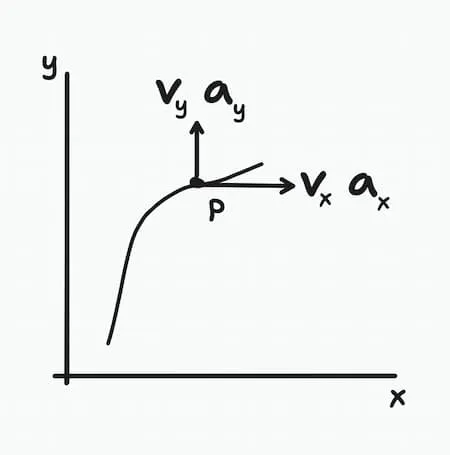
vy=dtdy=y˙∧vx=dtdx=x˙
ay=dt2d2y=y¨∧ax=dt2d2x=x¨
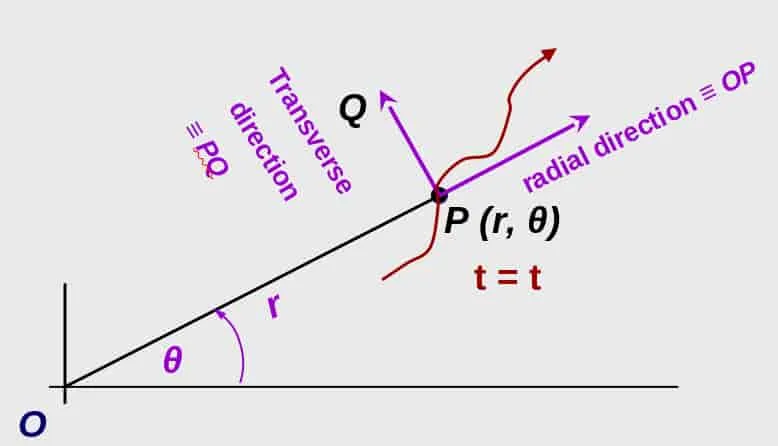
Velocity have a transverse and radial components.
- Transverse component vθ=θ˙×r
- Radial component vr=r˙
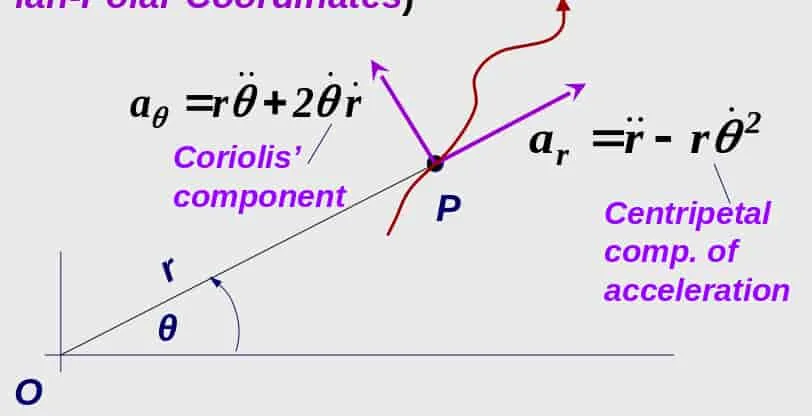
Acceleration also have a transverse and radial components.
- Transverse component
- aθ=rθ¨+2θ˙r˙
- In vector equation:
aθ=θ¨×r+2(θ˙×r˙)
- Radial component
- ar=r¨−rθ˙2
- ar=r¨+θ˙×(θ˙×r)
In the acceleration:
- Coriolis’ component of acceleration
2θ˙r˙
- Centripetal component of acceleration
−rθ˙2=θ˙×(θ˙×r)
Effects of Coriolis’ Component
- Objects reflect to the right in the northern hemisphere
- Objects reflect to the left in the southern hemisphere
- Maximum deflections occur at the poles. No deflection at the equator.
Unit Vectors
Unit vectors in transverse and radial directions are denoted by eθ and
er respectively.
e˙r=θ˙eθ∧e˙θ=−θ˙er
Velocity
v=dtd(rer)=r˙er+re˙r=r˙er+rθ˙eθ
Acceleration
a=dtd(rθ˙eθ)=(r¨−rθ˙2)er+(rθ¨+2θ˙r˙)eθ